How to Calculate Sports Betting Probability
Table of Contents
- What Betting Odds and Implied Probability Mean
- How to Calculate Implied Probability from American Odds
- Converting Decimal Odds to Probability
- Converting Fractional Odds to Probability
- Understanding Bookmaker Margin and De-Vigging
- Using an Implied Probability Calculator
- Implied Probability vs. True Probability: Finding Value
- A Complete Worked Example Across All Odds Formats
- Frequently Asked Questions
Last Updated: October 12, 2026
What Betting Odds and Implied Probability Mean
Implied probability is the likelihood of an outcome, expressed as a percentage, derived from the odds a bookmaker sets.
Odds are a pricing system: bookmakers adjust true probabilities to guarantee an edge.
The three main odds formats, American, decimal, and fractional, look different but contain the same information.
Once you can calculate sports betting probability from any odds format, you can compare your own estimates against the market.
How to Calculate Implied Probability from American Odds
American odds use a baseline of 100. Negative odds show favorites. Positive odds show underdogs. The further from zero, the stronger the implied probability.
Positive American Odds Formula
Positive odds show profit on a $100 stake, +150 wins $150 on a $100 bet.
To calculate sports betting probability from positive odds, use this formula:
Implied Probability = 100 / (Odds + 100)
Example: +150 odds
- Implied Probability = 100 / (150 + 100)
- Implied Probability = 100 / 250
- Implied Probability = 0.40 or 40%
The bookmaker prices the outcome at 40% likelihood.
Negative American Odds Formula
Negative odds show how much you must stake to win $100, -150 risks $150 to win $100.
To calculate sports betting probability from negative odds:
Implied Probability = Odds / (Odds + 100)
Note: Drop the minus sign. Use only the number.
Example: -150 odds
- Implied Probability = 150 / (150 + 100)
- Implied Probability = 150 / 250
- Implied Probability = 0.60 or 60%
The market prices this favorite at 60% probability, the flip side of the +150 underdog above.
Converting Decimal Odds to Probability
Decimal odds, common in Europe and Australia, show total return per dollar staked, including your original bet.
Decimal odds of 2.50 return $2.50 per $1 wagered, including the $1 stake, a $1.50 profit.
To calculate sports betting probability from decimal odds:
Implied Probability = 1 / Decimal Odds
Example: 2.50 decimal odds
- Implied Probability = 1 / 2.50
- Implied Probability = 0.40 or 40%
Example: +150 American = (150 + 100) / 100 = 2.50 decimal
Many bettors prefer decimal because the calculation is one simple division.
Converting Fractional Odds to Probability
Fractional odds appear in UK and Irish betting, shown as 3/1, 5/2, or 11/10.
The first number is profit, the second is stake: 3/1 means $3 profit on a $1 bet, for a $4 total return.
To calculate sports betting probability from fractional odds:
Implied Probability = Denominator / (Denominator + Numerator)
Example: 3/1 fractional odds
- Implied Probability = 1 / (1 + 3)
- Implied Probability = 1 / 4
- Implied Probability = 0.25 or 25%
Example: 5/2 fractional odds
- Implied Probability = 2 / (2 + 5)
- Implied Probability = 2 / 7
- Implied Probability = 0.286 or 28.6%
Converting fractional to decimal: add 1 to (numerator / denominator), so 3/1 becomes (3 / 1) + 1 = 4.0 decimal.
Understanding Bookmaker Margin and De-Vigging
Bookmakers don't set odds on true probability alone. They add a built-in margin called the vig, juice, or overround, guaranteeing profit regardless of outcome.
When you calculate implied probability for every outcome in a market, the percentages add to more than 100%. The excess is the bookmaker's edge.
Example: NFL game, two-way market
- Team A: -110 American odds = 52.4% implied probability
- Team B: -110 American odds = 52.4% implied probability
- Total: 104.8%
The extra 4.8% is the vig, ensuring bookmaker profit no matter which side wins.
Why a Two-Way Example Isn't Enough
Most guides stop at the -110/-110 example because both sides are symmetric, so splitting the vig evenly happens to work. Real markets are rarely symmetric and often have more than two outcomes, a three-way soccer market, a futures market with 20+ runners, or a lopsided NFL game all require the same proportional method, but the arithmetic exposes mistakes the symmetric example hides.
Proportional De-Vigging, Step by Step
The most common method is proportional de-vigging: divide each outcome's implied probability by the sum of all implied probabilities in the market.
De-Vigged Probability = Outcome Probability / Sum of All Outcome Probabilities
This preserves relative pricing between outcomes while scaling the total back to 100%.
Worked Example: A Three-Way Soccer Market
Consider a Premier League match with three outcomes: Home win, Draw, Away win.
Step 1: Convert each outcome to implied probability
- Home win: 2.10 decimal → 1 / 2.10 = 47.62%
- Draw: 3.40 decimal → 1 / 3.40 = 29.41%
- Away win: 3.60 decimal → 1 / 3.60 = 27.78%
The 4.81% overround is the bookmaker's margin on this market.
Step 2: Divide each outcome by the sum
- Home win: 47.62% / 104.81% = 45.44%
- Draw: 29.41% / 104.81% = 28.06%
- Away win: 27.78% / 104.81% = 26.50%
Those are the fair market probabilities. The vig wasn't split evenly, the favorite absorbed a larger share of the margin than the longshots, typical because recreational money piles on favorites.
Step 3: Convert fair probabilities back to fair odds
- Home win: 1 / 0.4544 = 2.20 decimal
- Draw: 1 / 0.2806 = 3.56 decimal
- Away win: 1 / 0.2650 = 3.77 decimal
No book offers margin-free prices, which is exactly why de-vigging matters for finding value.
Other De-Vigging Methods You'll See
Proportional de-vigging is the standard, but two other approaches appear in betting literature:
- Multiplicative (Shin) method: Adjusts for longshots carrying a higher effective margin than favorites. More accurate for extreme longshots, but harder to compute by hand.
- Additive method: Subtracts an equal share of the vig from each outcome. Simple, but can produce negative probabilities on heavy longshots, so it's rarely used.
For most bettors, proportional de-vigging is accurate enough. On a 50/1 longshot, the Shin method gives a slightly higher fair probability, but the difference is small relative to the uncertainty in your own estimate.
What De-Vigging Actually Tells You
De-vigging doesn't reveal the "true" probability of an outcome, it reveals the market's best guess with the margin stripped out. That's a useful benchmark, but still a consensus of bettors and the book's models, not objective truth.
The practical use is comparison: if your estimate is higher than the de-vigged market probability, you may have found value; if lower, the market is pricing it more aggressively than you would.
Using an Implied Probability Calculator
Manual calculation works, but lines move fast, a calculator helps you compare odds across books instantly.
Most online calculators take odds in any format and output the implied percentage in seconds.
Some also show payouts: input your stake and odds to get total return and profit.
Free calculators exist but are often slow or ad-cluttered; dedicated betting tools integrate probability conversion with other analysis.
Implied Probability vs. True Probability: Finding Value
Implied probability is what the market thinks; true probability is what you think.
The gap between them is value.
This is the core discipline of serious betting: not predicting outcomes, but finding situations where your probability estimate beats the bookmaker's.
Most casual bettors ignore this, picking winners on hunches, recent form, or hearsay without ever checking whether the odds justify the bet.
Why Implied Probability Is Not a Prediction
A common mistake is treating the de-vigged market probability as the "real" probability. It isn't, it's a price reflecting every bettor and model that moved the line plus the bookmaker's risk management. Markets can be wrong, which is the entire premise of value betting.
Two consequences follow:
- A 60% implied probability does not mean the outcome happens 60% of the time. It means the market prices it as if it does. Over a large sample, well-priced favorites win close to their implied rate, but any single game can go either way.
- You don't need to be right more often than the market to profit. You need your estimates better calibrated than the market's on the specific bets you place, a narrower, more achievable goal.
How to Build a True Probability Estimate
There's no single formula for true probability, but most practitioners follow a similar workflow:
1. Start with a baseline. For team sports, use a rating system (Elo, power ratings, or points-per-game); for player props, the player's recent rate stats adjusted for opponent. This gives a rough number before adding context.
2. Adjust for situational factors. Injuries, rest days, travel, weather, referee tendencies, and lineup changes all shift probabilities, and each adjustment should be grounded in historical data.
**3.
4. Compare to the de-vigged market. If your number is meaningfully higher, you have a candidate bet.
5. Track your results. Estimates are only as good as their calibration.
A Concrete Example
Suppose the de-vigged market probability for an NFL team to win is 52.1%. You build your own estimate:
- Baseline rating: Team A is 2.5 points better on a neutral field.
- Home-field adjustment: +2.5 points for Team A (home teams historically get roughly a 2-3 point edge in the NFL).
- Injury adjustment: Team B's starting left tackle is out, worth roughly -1 point to Team B's offense.
Converting a 6-point edge with a 13.5-point standard deviation gives roughly a 67% win probability for Team A, well above the market's 52.1%. Edges that big are rare and often signal a modeling error, so they warrant a closer look at your inputs.
A more realistic edge might be 55% vs. 52.1%, a 2.9% gap, small but potentially actionable if your model is well-calibrated.
The Difference Between Edge and Certainty
Finding a 3% edge doesn't mean you'll win the bet, it means the bet has positive expected value if your estimate is correct. You'll still lose roughly 45% of the time on a 55% probability bet; profit comes from the long run.
This is why bankroll management matters as much as probability estimation: even a genuine edge can wipe out a bankroll if bet sizes are too large relative to variance.
Where Heater Fits In
Heater automates the workflow above. It runs independent simulations for NFL, College Football, NHL, MLB, NBA, College Basketball, and PGA, converts bookmaker odds into implied probabilities, de-vigs the market, and compares those numbers against Heater's own estimates.
The difference between implied and true probability is also why you see "pass" recommendations. If Heater's analysis finds no edge, it tells you to skip the bet. That discipline saves money faster than picking winners ever will.
A Complete Worked Example Across All Odds Formats
Let's walk through an NFL game between Team A (favorite) and Team B (underdog).
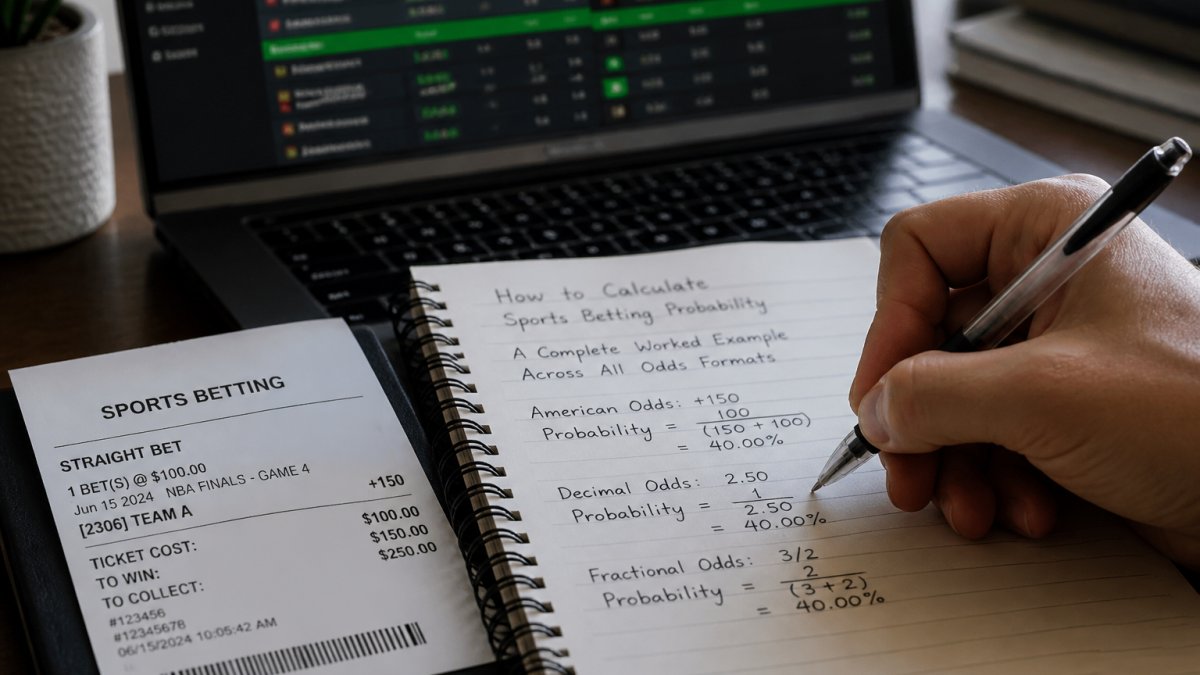
American Odds:
- Team A: -120
- Team B: +100
Step 1: Convert to implied probability
Team A (negative odds):
- Implied Probability = 120 / (120 + 100) = 120 / 220 = 54.5%
Team B (positive odds):
- Implied Probability = 100 / (100 + 100) = 100 / 200 = 50%
Total: 54.5% + 50% = 104.5% (the 4.5% is bookmaker margin)
Step 2: De-vig to find fair probability
- Team A: 54.5% / 104.5% = 52.1%
- Team B: 50% / 104.5% = 47.9%
The true market probability is 52.1% vs. 47.9%.
Step 3: Convert to other formats
Decimal odds (divide American by 100, then add 1):
- Team A: (120 / 100) + 1 = 2.20 decimal
- Team B: (100 / 100) + 1 = 2.00 decimal
Fractional odds (American divided by 100):
- Team A: 120/100 = 6/5 fractional
- Team B: 100/100 = 1/1 fractional
Step 4: Calculate payout on a $100 stake
Team A at -120:
- Profit = 100 / 1.20 = $83.33
- Total return = $100 + $83.33 = $183.33
Team B at +100:
- Profit = 100 × 1.00 = $100
- Total return = $100 + $100 = $200
Step 5: Find your edge
Now you compare.
Conversely, if you think Team A is only 50% likely, the market is overpricing it.
Sports betting rewards precision: casual bettors guess, serious bettors calculate.
Get started with Heater and access AI-driven analysis that automates probability conversion and edge detection.
Frequently Asked Questions
How do you convert betting odds into implied probability?
Implied probability converts the odds a bookmaker offers into a percentage chance of an outcome occurring. For American odds, use 100/(odds+100) for negative odds or odds/(odds+100) for positive odds. For decimal odds, divide 1 by the decimal odds. For fractional odds, divide denominator by (denominator + numerator). These formulas extract the probability the bookmaker is pricing into the odds.
What is the difference between implied probability and true probability?
Implied probability reflects what the bookmaker's odds suggest will happen, but it includes the bookmaker's margin (vig). True probability is what you believe will actually happen based on your own analysis. If your true probability estimate exceeds the implied probability, the bet offers value. This gap between market-implied chances and your independent assessment is where profitable betting edges emerge.
How do you account for bookmaker margin when calculating probability?
Bookmaker margin (vig) is built into all odds. To remove it, calculate implied probability for every outcome in a market, sum them (they'll total over 100%), then divide each individual probability by that sum. This de-vigging process reveals the fair probability underneath the bookmaker's margin, allowing you to compare your own probability estimates against true market-implied odds rather than inflated ones.
What is the formula for implied probability from American odds?
For negative American odds: Implied Probability = |Odds| / (|Odds| + 100). For positive American odds: Implied Probability = 100 / (Odds + 100). These formulas show what percentage chance the bookmaker is pricing in. Negative odds represent favorites (higher implied probability), while positive odds represent underdogs (lower implied probability).